Beating the heat with chickens

While we were on the Hawaiian island of Kauai, we saw dozens and dozens of chickens everywhere we went, frolicking in the balmy weather just as we did in our t-shirts and shorts. I’ll probably do a whole separate post on those chickens, who are a hoot in their own right, but that whole experience was misleading with regard to how chickens actually like their weather.

You can read more at the North Carolina Cooperative Extension Service about the temperatures where chickens start feeling poorly (and egg production sinks) but the basic sweet spot for chickens is where humans live – 65-75 degrees Farenheit. Above that temperature, chickens suffer because unlike us humans – they can’t sweat.  When they get too hot,  pant like dogs to get rid of heat, and it’s just not as efficient as our system.

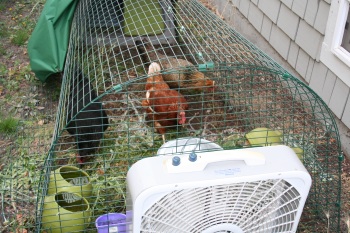
Chickens in Eglu with white fan pointed straight at them

Climate change has made summers in Seattle quite variable and in 2009 we reached the high 90s and at least one point 100 degrees. Jason feared for the chickens as did I, so he moved them to the side of the yard where the house and shrubs blocked light and then ran an outdoor extension cord and fan straight down the Eglu.  You can see he also kept the water dishes very full, and he tried different fan arrangements.

Chickens don’t like eating in wind tunnels but they did all survive the heat wave.


Posted in Uncategorized | Tagged | Comments Off on Beating the heat with chickens

Adventure, danger and chickens

On this morning, I was overly influenced by the League of Extraordinary Gentlemen and wanted to do it, chicken-style.

Two chickens in bowlers, one with a gun, smackdown!

Posted in Uncategorized | Tagged | Comments Off on Adventure, danger and chickens

Anatomy of a Chicken Coop

After being enamored of the idea, every would-be urban chicken owner has to face the reality of money, time they have to deal with making a coop, and size of their lawn in order to figure out what kind of future lifestyle the urban chickens can have.

If you are short on time, have some money, and have a smaller lawn, you may go the way we did. If you have more time and craftsmanship, and want to save money, there are multiple resources online for building your own coop.

Instructables have several examples from their community on how to build one – this one looks simplest/cheapest: http://www.instructables.com/id/how-to-build-a-cheap-chicken-coop/ and here’s one that took third prize in an Instructables contest: http://www.instructables.com/id/Easy-Chicken-Coop-for-the-City-Dweller/ . However, if you want swanky, check out the cedar condo also on Instructables : http://www.instructables.com/id/Cedar-chicken-coop-condo/

I managed to sell Jason on chicken raising with this thoroughly modern coop from the Omlet company in the UK ( see more at omlet.com).  The recycled plastic meant we didn’t have to worry about keeping wood free of pests, and (like that hamster cage) it could be hosted out with regularity and not have to worry about wood rot.

However, he couldn’t completely stay away from the handyman thing – unlike the expensive coop (seen in photo below), the Omlet Eglu of that era did not come with wheels for moving the setup around to give the chickens fresh grass to scratch at.  (These kinds of coops I have found are also called “chicken tractors.”

J  did go to the hardware store, buy an axle, and rather than try to drill into the plastic (ruining the integrity of the Eglu) he affixed a big plank on top. He drags the coop onto the board, then uses that setup to help him wheel the coop around what can be very soggy Seattle lawn.

The basics of a chicken coop are as follows – you need an enclosed place with a door that shuts for them to sleep/roost, a concave space or nesting box  (1 per 4 hens) to push out an egg in comfort ( some coops may have straw inside boxes, the Omlet Eglu has a nice egg bowl), means for ventilation, water and food bowls/bins.  If you put the chicken run together with the coop as the Omlet Eglu does, then you will also need places to hang the water and feed inside the run, so that squirrels etc don’t consume the chickens’ nourishment out from under them. Rats remember are attracted to poop and the food the chickens eat – and in Seattle the rats can be very mean.

The coop also needs to be predator proof (hence shutting door, a run that flares outward so animals are unable to burrow underneath to get the chickens).  If you want more specifics, check out the My Pet Chicken ebook chapter on coops.

The For Dummies series also has a good set of questions to ask yourself if you (like us) go the pre-fab coop route.

To save money, you can make your own – just think a bit about the need to clean them and the design before you begin, in order to save yourself work later. If you have money to blow, you can always get a coop similar to one our friend Eileen in the UK had – a brightly painted “wheelbarrow” sort of coop.

http://www.mypetchicken.com/catalog/chickens/Push-It-Coop-3-5-Chickens-p902.aspx

Where we live, Seattle Tilth actually sponsors a tour so that people can see the varieties of coops and other urban farming setups – it takes place in July this year. You can see photos of some sample coops from the tour last year.

And finally, sometimes people have to move, and they can’t take their chickens and/or their coop with them. Looking on Seattle’s version of Craigslist right now I’m seeing numerous listings for coops of various ages, sometimes with chickens included.  You may inherit an urban chicken setup from a neighbor or friend who has to relocate for no work, no money down (just bring the truck over to the house to get it).

Sample Craigslist Listing:

Just be sure to disinfect an old coop before putting new chickens in it – one blogger recommends vinegar rather than bleach – you can also get virus-smiting hardcore (very much need to wash yourself and the coop down afterward) stuff from McMurray Hatchery. Just remember, it makes no sense to give your chickens organic feed, free range, all that jazz just to leave toxic chemicals on their coop – hose that sucker down after the disinfecting ends. Read all labels and scrub hard.


Posted in Uncategorized | Tagged | Comments Off on Anatomy of a Chicken Coop

Meaning of life: solved

chicken pondering with bag of popcorn

Posted in Uncategorized | Tagged | Comments Off on Meaning of life: solved

How I stopped worrying and learned to love the (sometimes spotty) lawn

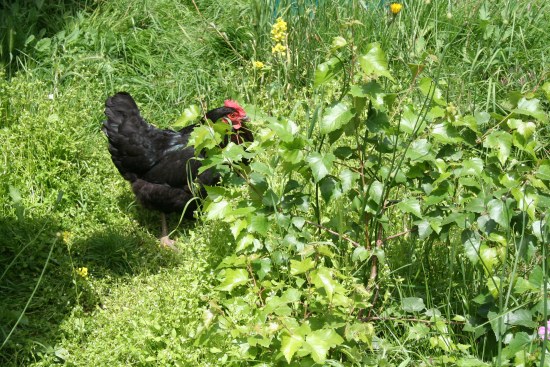
Bossy Chicken in Summer Overgrown Lawn

Bossy Chicken Faces Down the Lawn

Our lawn was not ever golf-course pristine or going to earn us special marks from our neighbors. We were lucky that prior residents had put in perennial shrubs that bloomed on time and without a lot of fertilizer or effort on our part. Our position halfway up a hill meant that our lawn would get soil and water from drainage patterns but was also destined to lose them as well.

We had a lawn service despite the postage-stamp nature of our lawn simply because my allergies were too hardcore to do the lawn work and J really wasn’t up to it.

All this changed when we got chickens. The nature of chickens is to love to scrabble in the turf, looking for bugs and worms and such, and unless we wanted a deep pit to China dug in any part of our lawn, we were going to have to practice “crop rotation” where the chickens could dig up only certain parts of the lawn at a time, and with luck the rest would grow back. J goes over the lawn with a mulching mower once in a while, but his real lawn maintenance is letting the chickens shorten and uproot the grass, pooping merrily on it as they go.

We know the chickens are good for the soil because their winter spot, under the deck no less, always sprouts a green layer of grass (possibly from their feed, possibly not) during the summer and that area used to be mostly dirt and gravel from the prior owners. To be clear, chicken poop on its own is not great fertilizer on its own – in fact, Seattle Tilth recommends you compost it first before putting into your garden or doing anything organized with it.

But you have to realize: we don’t care about having a picture perfect lawn. At any given point there’s a bare patch and a jungle thanks to the chickens, and while J beats back the strange vines and prickly shrubs we’ve sworn to get rid of, it’s really about ensuring the Japanese maple and the newly planted blueberry and rosemary bushes survive, and that’s that. Our lawn isn’t for anyone to try to keep up with – it’s the chicken’s playground. If you are in a planned unit development or just have anxiety attacks about what people think about your lawn you should

a) have a bigger acreage than we do, and keep the chickens way back where no one will see them, fenced in
b) keep the chickens under the deck/in one spot but be prepared for them to be sad a lot
c) find other medication to dispel the anxiety attacks and realize they have nothing to do with how good your lawn is, they are from something else 🙂

While chickens cost us a decent amount in feed and labor, it is pretty well made up for in that we don’t have a lawn guy in mowing the lawn at roughly 30+ dollars a go twice a month in the summer.

Oh yes – for those with acreage and green thumbs -remember that chickens are nature’s rototillers and if you want to keep your garden producing for human beings – you need to do some fancy fencing and keep the chickens OUT of the veggies and florals.

Posted in Uncategorized | Tagged | Comments Off on How I stopped worrying and learned to love the (sometimes spotty) lawn

Video Intro to Shy Chicken, Bossy Chicken and Business Chicken

It’s hard for us to figure out how to explain the humor that is watching chickens walk around.  Maybe better to give you a more dignified video introduction – very typical of whenever I approach the coop – and then one day sneak up on them to show antics.

The red one is Shy Chicken, the black one is Bossy Chicken, and the speckled one is Business Chicken. This was taken in the heat of summer in 2010, when the lawn had dried out a bit and they had stopped making the mournful bawking they reserve for Seattle’s crappiest gray days full of rain. Sometime I need to get the gloomy bawking on camera but for now, enjoy the crackling sunshine…


Posted in Uncategorized | Tagged | Comments Off on Video Intro to Shy Chicken, Bossy Chicken and Business Chicken

What’s with the chicken cartoons?

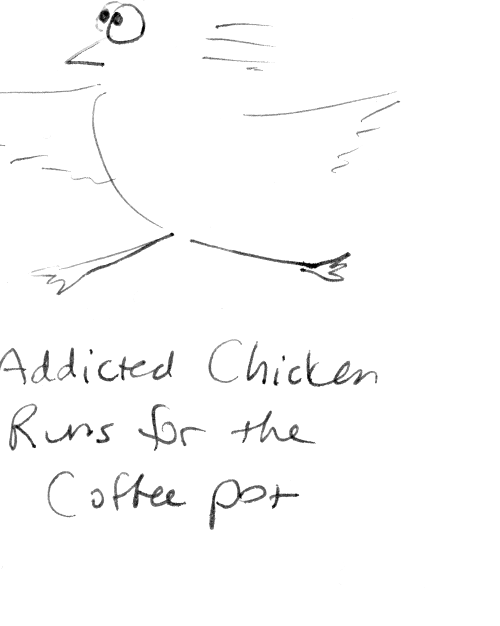
Chicken running across frame


I first started leaving little chicken post-it notes for my husband when I went to work.

Somehow, as a computer programmer, he could always sleep in and I was struggling to get to some meeting or another.

The yellow looks wonky when I started posting them to the blog, so I made them black and white.

Posted in Uncategorized | Tagged | Comments Off on What’s with the chicken cartoons?

Urban chickens – are they for everyone?

So you want chickens.

First, you have to ask yourself – is it legal? There are some places in the US where it is not lawful to have chickens living at your house, though at the time we got ours in Seattle, the legal limit for this “sexy urban pet” was three. This great resource from Seattle Tilth about keeping chickens includes a link to the watchdog group on chicken laws.

Second, you have to ask yourself, am I the chicken type? If you are the kind of person who, as a kid, would do ANYTHING NUT clean out the hamster poop from the cage, you may not have the inner strength needed to handle live bawking chickens. There is poop my friend. There is poop indeed.

Chickens are more high-maintenance than cats –the kitties you can leave alone in the house for a weekend or a week and they will be fine with the proper automated water/feed dishes. For chickens, water and feed bowls tend to need cleaning/refilling every three days, and in the winter, their water can freeze which is a severe problem for the chickens. If you have a coop like the Omlet Eglu and have three chickens, there is no room in the coop for a water dish – if you lock the chickens in at night for warmth or to protect from predators, someone has to be up at the crack of dawn to let those chickens out or they can die of dehydration (they don’t seem to mind stacking themselves like sardines at night in the coop).

That said, though you have to be home, it’s not labor-intensive to keep the chickens the way we do. The J reports it’s a little over an hour a week of heavy duty poop removal and coop moving (we move our coop around the yard so the chickens have new areas to dig up and fertilize).

Third, can your yard take it?

We have a postage-stamp sized yard that barely accommodates the chickens well enough that grass can regrow where they lay waste and dig up the ground. Think of chickens as a constantly squawking rototiller – they love bugs and worms, and their nature is to root around and dig up things. Our lawn’s soil needed the aeration and fertilizer having rotating chicken presence would provide and we are ok with our yard looking like an English meadow (the parts that are waiting to be dug up by the chickens, I mean).  People who have gardens,  will want to keep the chickens away from the fruits of the harvest.  People who pride themselves on having a lawn that you could invite golf pros to walk on probably should keep chickens on another estate. (Insert languid duchess wave of hand here…)

The other answer, if you have garden/golf course on your property you don’t want ruined, is to keep the coop in one spot and do the “wood shaving” method (remember that hamster cage above? Same idea). We put the chicken coop under the deck in the winter during Seattle’s freak snow season to keep them out of the snow and slightly warmer (as it was closer to the house. The other reason of course is in winter, the lawn doesn’t grow back at all, so it’s no fun for the chickens anyway to get the coop moved around.

Fourth, will your pets/neighborhood animals/ neighbors be jealous? This matters more if you decide to let the chickens run free in your yard (maybe you have a bigger yard or true acreage – they will automatically go into the coop each night regardless).  We have cats and even with the chickens loose, the chickens’ claws and size relative to the cats means the chicken’s don’t get messed with (and Bossy Chicken least of all). However, we’ve heard of other chickens being carried off (hawks, stray dog, coyotes) in the Puget Sound region so think carefully about protecting your chicken from predators.

We’ve had an interesting experience where now our neighbors who have small kids bring them into our yard and show off the chickens each day to their kids. It’s a little unnerving seeing people just walk into your yard, but you can expect to be a curiosity (at least until all your neighbors invest in chickens) for a while. Hopefully your neighbors are not the egg-rustling type.

Our closest neighbors grew up with chickens and/or don’t care about the noise. There’s no rooster, which is a mercy, (they were also illegal in the city limits when we got ours) but they do fuss at times about nothing, and it helps that the neighborhood just doesn’t care about the chicken audio.

Fifth, will chicken steading ruin my image as urban hipster?

The J and I bought our chicken setup and chickens really after urban chickens started becoming popular in Seattle but not at the height of the boom (it’s still ongoing). Other cultural associations – that poor people keep chickens, that only rural people keep chickens – may have more credence in your area. Ironically we bought ours as avian flu was all over the news – at this writing, that stigma/worry has subsided.

Honestly, though keeping chickens is cool, keeping chickens will not ensure that people think YOU are cool. You have to be in it for the all-day comedy show that is Chicken TV, and really not expect the chickens to move upward from dumber than a bunch of rocks.

And finally – remember these guys have dino brains. Literally. If you have a kid, it will get smart. Even our cats learned how to unlock doors over time. The chickens, as The J noted, behave like a really badly designed video game AI module. Even though they have passed through the chicken run door a million times, that doesn’t mean they understand it’s a door when they are outside the coop setup . Sitting next to a chicken, it is the dinosaur, you are the Einstein. Trust us on this one.

So think carefully. Other blog posts on this site will tackle our setup so people can see how it works and whether it would be good for them.

Bawk-bawk!

Posted in Uncategorized | Tagged | Comments Off on Urban chickens – are they for everyone?

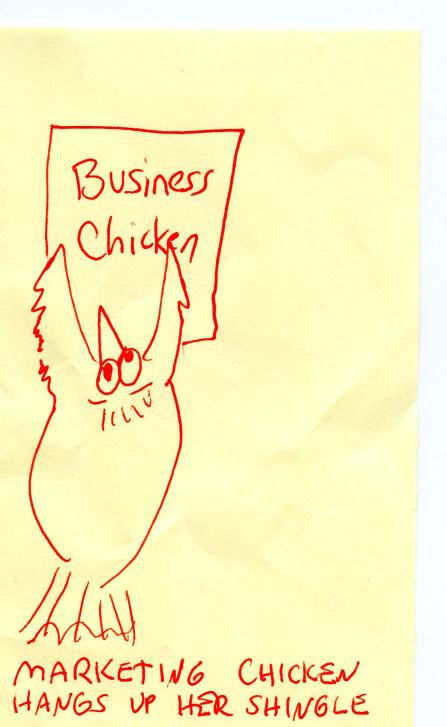
Putting up the shingle

Posted in Uncategorized | Tagged | Comments Off on Putting up the shingle